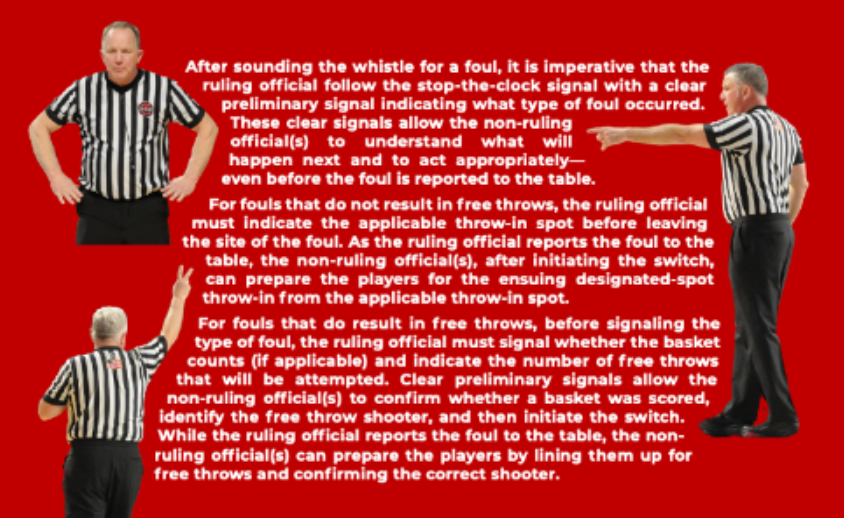
Continuous Motion… The rule exists to allow an offensive player to complete a legitimate try or tap for goal when any defensive foul occurs during the shooting attempt. When a defensive foul occurs after the habitual throwing motion has started, the rule permits the shooter to complete the normal shooting motion, including customary arm, foot, and body movements.
It is important to remember that the rule applies once the customary movements have begun. One area where we see a lack of a clear understanding is in regard to foot movements once the try starts.
A couple of scenarios:
Scenario 1…A1 has ended the dribble in the free throw lane and is stepping toward the basket. B1 fouls A1. A1 legally finishes their last step before immediately jumping to attempt a try or lay the ball in the basket.
RULING: If the try is successful, the goal counts. If the try is unsuccessful, A1 will be awarded two free throws as it was a two-point attempt.
Scenario 2…A1 has ended the dribble in the free throw lane and is pivoting toward the basket. B1 fouls A1. A1 completes the pivot, before immediately jumping to attempt a try.
RULING: If the try is successful, the goal counts. If the try is unsuccessful, A1 will be awarded two free throws as it was a two-point attempt.
COMMENT: It should be noted that A1 does not have to be stepping toward the goal for continuous motion to apply. Some shot attempts require a player to step away from the basket. This stepping away begins the habitual throwing motion that precedes a try (e.g. “step back” jump shot). The key here is that it is part of the customary habitual throwing motion. Do not penalize the offense by ruling a common foul when the shooter is stepping back to attempt the shot and is fouled. That step back is part of the habitual throwing motion.
Uniforms…We are continuing to see teams wearing uniforms that do not meet rules criteria. The HSL Office has put considerable emphasis on enforcement of uniform rules this season. There are a couple of particular areas of concern.
First, undershirts. If the torso color of the jersey is white, then the tee shirt must be white. There are no exceptions to this rule.

If the torso color of the jersey is not white, then the undershirt must match the color of the jersey or be black. All players who wear a tee shirt MUST wear the same color.

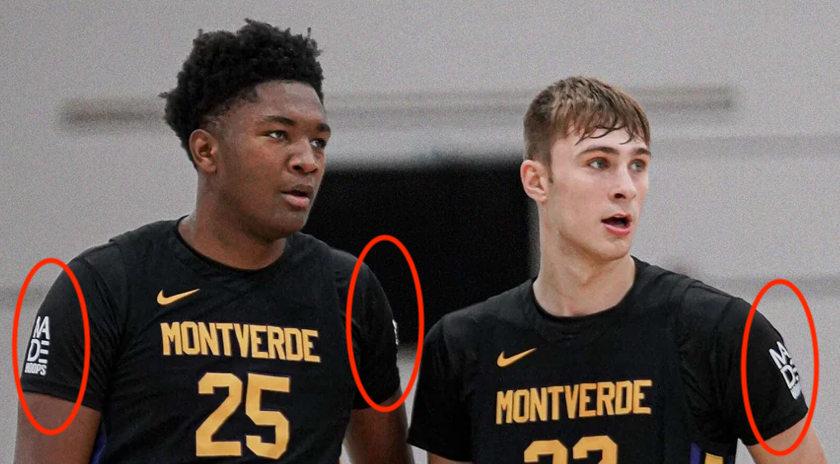
Please note that “MADE HOOPS” tee shirts that have the logo on the sleeve are not legal (see below). Two reasons…the logo is too large and only one logo is permitted.
The second area of enforcement is uniforms being worn properly. Players are expected to keep the jerseys tucked in. If they come out during play, the player is expected to tuck the jersey back in without officials having to remind him/her. If a sub comes to the table and is not properly attired (specifically the jersey being worn properly), do not allow the sub into the game. Ignore any protests from coaches regarding this.
Tip